

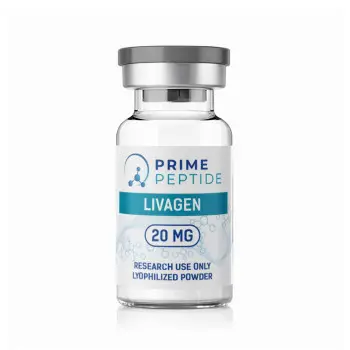
Livagen (Livagen) 20mg
56,25 €
Livagen (KEDA) is a short synthetic peptide composed of four amino acids in the sequence Lys-Glu-Asp-Ala (lysine, glutamic acid, aspartic acid, and alanine). It belongs to the group of short peptide bioregulators developed and studied by the scientific school of Professor Vladimir Khavinson.
What is Livagen?
Livagen (KEDA) is a short synthetic peptide composed of four amino acids – Lys-Glu-Asp-Ala (lysine–glutamic acid–aspartic acid–alanine). It belongs to the group of so-called short peptide bioregulators developed and studied within the scientific school of Professor Vladimir Khavinson.
Livagen has traditionally been considered a peptide associated with research into liver tissue, cellular regulation and aging processes. In scientific literature, particular interest focuses on the ability of very short peptide sequences to influence cellular processes, including chromatin organization and gene activity.
One of the most interesting areas of Livagen research is chromatin regulation. Experiments with cultured lymphocytes from older individuals have observed changes in heterochromatin status and ribosomal gene activity after exposure to Livagen.
For this reason, Livagen is also of interest in gerontology and anti-aging research, which studies the mechanisms by which aging changes gene expression and the functional state of cells.
Livagen is not approved by the FDA or EMA as a medicinal product and remains an entirely experimental peptide.
What are the benefits of Livagen?
Support for liver cell function
Livagen is traditionally classified as a liver-targeted peptide bioregulator. Experimental interest focuses on the mechanisms regulating the functional activity of hepatocytes and the response of liver tissue to different forms of cellular stress.
Gene expression and chromatin
DNA in the cell nucleus is organized as chromatin. When certain regions are highly condensed, access to them, and therefore expression of some genes, may be restricted.
In cellular experiments, Livagen has been associated with heterochromatin decondensation and changes in ribosomal gene activity in lymphocytes from older donors.
Research on cellular aging
As age increases, changes occur in chromatin organization and in the regulation of gene expression.
The observed influence of Livagen on chromatin is one reason why the peptide is of interest in experimental gerontology and the biology of aging.
Cellular regulation
Short peptide bioregulators are investigated for their potential to interact with processes that control cellular activity and gene expression.
With Livagen, the research focus is on its potential involvement in regulating cellular processes associated with age and the functional state of certain tissues.
Liver regeneration
Livagen is often described as a peptide used to investigate regenerative processes in the liver.
Antioxidant and protective mechanisms
Research on peptide bioregulators examines interactions with various mechanisms of cellular protection and adaptation to oxidative stress.
Immune regulation
Some experimental studies of Livagen have been conducted on lymphocytes.
Changes in chromatin organization and cellular activity have been observed, prompting interest in possible interactions between Livagen, aging and the immune system.
Anti-aging research
Livagen belongs to the group of peptide bioregulators studied in the context of age-related changes in cellular function.
The main interest lies in gene regulation, chromatin structure and cellular adaptation, rather than a directly demonstrated “rejuvenating” effect.
Clinical trials of Livagen
The scientific evidence base for Livagen is unusual compared with better-studied peptides.
Publications exist from research groups associated with the development of peptide bioregulators, but a substantial proportion of the data comes from in vitro, ex vivo and preclinical models.
One of the most frequently cited publications examines the effects of Livagen on lymphocytes from older people. The authors reported changes in heterochromatin and activation of ribosomal genes following exposure to the peptide.
Contemporary literature reviews emphasize the lack of high-quality, independent Western randomized controlled trials establishing the clinical efficacy, optimal dose and long-term safety of synthetic KEDA in humans.
Consequently, Livagen should primarily be regarded as an experimental research peptide.
Experimental protocols and dosage of Livagen
Experimental protocols conducted in laboratory settings may include injectable amounts of approximately 1–5 mg per exposure and short cyclical regimens of around 10–20 days.
Possible side effects of Livagen
Livagen is generally considered well tolerated within research protocols. Reported adverse effects are rare and usually mild:
- Mild redness or discomfort at the application site.
- Headache – brief and low in intensity.
- Fatigue – some users may experience a temporary change in energy levels.
- Mild changes in sleep – short-term fluctuations may occur.
- Changes in appetite – rare and generally mild.
Overall, the tolerability profile of Livagen is considered favorable.
Comparison of Livagen with other peptides
Livagen vs Epitalon
Epitalon (AEDG) is another representative of the school of short peptide bioregulators. While Livagen has traditionally been associated with liver tissue and cellular regulation, Epitalon has mainly been studied in the context of aging, the pineal gland, cellular proliferation and telomere biology.
Both are short tetrapeptides, but they have different amino acid sequences and should not be considered interchangeable.
Livagen vs NAD+
NAD+ is a coenzyme with a fundamental role in cellular energy metabolism, redox reactions and numerous enzymatic processes.
Livagen is a short peptide whose research profile is more strongly focused on gene regulation, chromatin organization and the concept of tissue-specific bioregulation.
Livagen vs Glutathione
Glutathione is a naturally occurring tripeptide and one of the main components of the intracellular antioxidant system.
There is a considerably larger scientific evidence base concerning its role in redox balance and protection against oxidative stress.
Livagen has a different research profile, primarily associated with short peptide bioregulators and gene/chromatin regulation.
Livagen vs MOTS-c
MOTS-c is a mitochondrially encoded peptide studied mainly in connection with cellular energy metabolism, glucose homeostasis and adaptation to metabolic stress.
Livagen belongs to an entirely different group – short synthetic bioregulatory peptides – with research interest focused primarily on cellular regulation and chromatin.
Livagen vs GHK-Cu
GHK-Cu is a copper-binding tripeptide studied mainly in relation to the skin, collagen, healing and tissue regeneration.
Livagen has no copper-binding mechanism and is studied in a completely different context – chromatin, gene activity and proposed tissue-specific bioregulation.
The information on this website has been collected and summarized from numerous scientific studies and analyses.
It is purely informational in nature and is not intended for diagnosing, treating or preventing diseases.
The products offered on the site are not classified as medicines or medical devices and are suitable solely for laboratory and scientific research purposes.