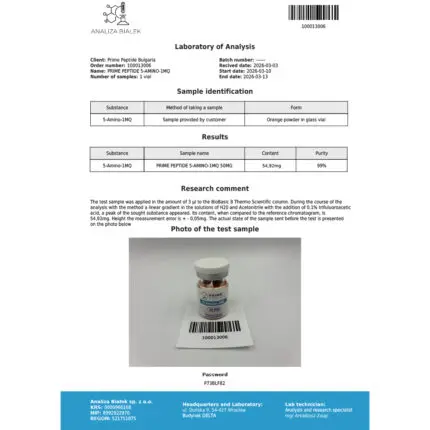


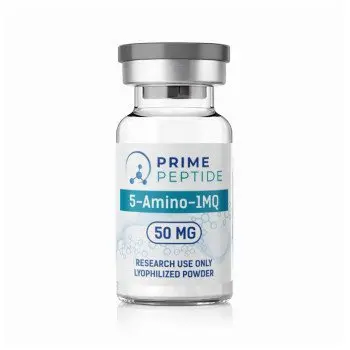
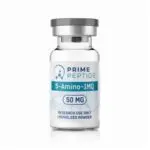

5-Amino-1MQ 50mg
56,25 €
5-Amino-1MQ (5-Amino-1-Methylquinolinium) is a synthetic small-molecule compound of a non-peptide nature. It is becoming increasingly well known for its association with the enzyme NNMT (Nicotinamide N-methyltransferase).
5-Amino-1MQ is an innovative metabolic compound that, in a research context, attracts strong interest for its potential to assist fat reduction, influence energy balance and improve body composition through a mechanism different from classical hormonal approaches. Thanks to its specific action it is regarded as one of the most interesting molecules in metabolism and weight control research.
What is 5-Amino-1MQ?
5-Amino-1MQ (5-Amino-1-Methylquinolinium) is not a peptide, but a synthetic small-molecule compound that is gaining popularity due to its connection with the enzyme NNMT (Nicotinamide N-methyltransferase).
NNMT is an enzyme associated with the regulation of energy metabolism, adipose tissue and the way the body uses calories. Increased activity of this enzyme is associated in scientific models with fat accumulation, lower energy expenditure and metabolic inefficiency.
5-Amino-1MQ is being studied as an inhibitor of NNMT, which means it may affect cellular mechanisms related to energy expenditure, fat metabolism, insulin sensitivity, body composition and mitochondrial function.
Unlike classical “fat loss” approaches, which rely on stimulants, appetite suppression or hormonal mechanisms, 5-Amino-1MQ attracts attention with a more cellular and metabolically targeted mode of action.
This is precisely what makes it a popular compound among circles focused on fat reduction and improving metabolic efficiency.
What are the benefits of 5-Amino-1MQ?
-
Assisting fat reduction
5-Amino-1MQ is being studied in relation to more efficient utilization of fat stores as an energy resource.
-
Improving body composition
It is associated with reduced fat mass while maintaining better physical balance.
-
Increasing energy expenditure
Part of the interest in the molecule comes from the potential for increased caloric expenditure at the cellular level.
-
Supporting metabolic function
It is considered in relation to more efficient use of carbohydrates and fats.
-
Improving insulin sensitivity
In scientific models, potential for better glucose control is being investigated.
-
Supporting mitochondrial activity
It is associated with more efficient cellular energy and metabolic flexibility.
-
Non-stimulant approach
Unlike classic thermogenic fat burners, it does not rely on stimulation of the nervous system.
-
Support during periods of stagnation
It is often considered for slowed progress and difficult fat reduction.
Clinical trials on 5-Amino-1MQ
5-Amino-1MQ is primarily the subject of preclinical and experimental studies aimed at the role of NNMT in metabolism and obesity.
In scientific models, data have been observed associated with:
- reduction of fat mass
- improved insulin sensitivity
- increased energy expenditure
- improved metabolic efficiency
- better control over body composition
Interest in the compound is growing, as it acts by a different mechanism compared to GLP-1 molecules and standard approaches for fat reduction.
Proper administration and dosage of 5-Amino-1MQ within a research protocol
In a research context 5-Amino-1MQ is usually administered via subcutaneous injection.
Common research ranges are from 50 – 100 mg daily, divided into 1 – 2 doses. In some protocols 100 – 150 mg daily are used for limited periods
Duration most often varies between 4 and 8 weeks, after which a break is usually planned.
A cyclic approach is often preferred in metabolic strategies and body recomposition protocols.
Possible side effects of 5-Amino-1MQ
At present data on tolerability are limited, but in practice mild and temporary reactions are most commonly reported.
Most common:
- mild headache
- stomach discomfort
- temporary fatigue
- dry mouth
Less common:
- mild nausea
- dizziness
- changes in appetite
In most cases the reactions are transient and dose-dependent.
Comparison of 5-Amino-1MQ with other peptides and molecules
5-Amino-1MQ vs AOD-9604
AOD-9604 is a peptide targeted at fat metabolism through a mechanism based on the action of a specific fragment of human growth hormone. 5-Amino-1MQ works through NNMT and cellular metabolic regulation. Both molecules are used in the context of fat reduction, but via different pathways.
5-Amino-1MQ vs Retatrutide
Retatrutide mainly acts through appetite control, incretin receptors and energy expenditure. 5-Amino-1MQ is not an appetite regulator, but rather a metabolically targeted compound at the cellular level.
5-Amino-1MQ vs MOTS-c
MOTS-c is a mitochondrial peptide associated with insulin sensitivity and cellular energy. 5-Amino-1MQ has a similar action in the metabolic sphere, but through a different enzymatic mechanism.
5-Amino-1MQ vs Adipotide
Adipotide is targeted at the vasculature of adipose tissue. 5-Amino-1MQ is a considerably more metabolic and enzyme-oriented approach.
The information on this website has been collected and summarized from numerous scientific studies and analyses.
It is entirely for informational purposes and is not intended for diagnosing, treating or preventing diseases.
The products offered on the site are not classified as medicines or medical devices and are suitable only for laboratory and scientific research purposes.