


Blog
GHK-Cu in a dual-chamber pen

What is a Dual-Chamber Pen?
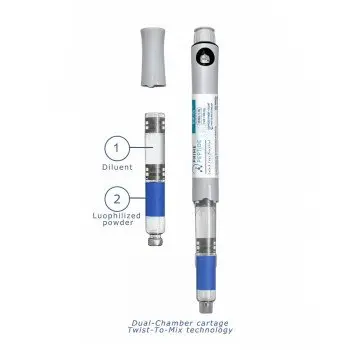
Dual-Chamber Pen is the name for a pen with two separate chambers. In the system described, one chamber contains a lyophilised peptide and the other a solvent. The components are kept separate within the cartridge during storage.
The reason for this design relates to peptide stability. Some peptides are more stable in a dry, lyophilised form than in solution. Contact with the liquid phase may lead to physical and chemical changes that affect their stability.
The dual-chamber concept allows separate storage of the components until they are combined in the cartridge. However, the design itself does not establish the sterility, stability, quality or safety of a particular product. Appropriate testing and documentation are required.
What is GHK-Cu?
GHK-Cu is a copper complex of the tripeptide glycyl-L-histidyl-L-lysine, consisting of glycine, histidine and lysine. It is also known as a copper peptide, and the copper ion contributes to its characteristic colour.
GHK was identified in the 1970s and occurs naturally in the human body. Research examines its role in cellular signalling and tissue repair. Concentrations of this peptide change with age.
Copper peptides are also found in cosmetic formulations such as skin serums. Findings concerning topical cosmetic use cannot automatically be extrapolated to injectable preparations.
Areas of scientific interest
- Collagen and elastin: research into the structural proteins of the skin.
- Wrinkles, complexion and texture: assessment of cosmetic effects.
- Hydration: research into skin barrier function.
- Tissue repair: investigation of cellular regeneration and healing.
- Inflammation and oxidative stress: examination of cellular responses.
- Hair and scalp: research into processes involving hair follicles.
Scientific and clinical research
The source discusses laboratory and dermatological research on GHK-Cu, particularly its relationship to collagen synthesis, elasticity and inflammatory processes. A distinction must be made between laboratory findings, cosmetic product studies and clinical evidence for the specific dual-chamber product.
Use in research protocols
The method of administration and testing conditions are determined by a specific approved research protocol. Experimental findings do not constitute a recommendation for self-administration, dosing or combining substances in humans.
Possible adverse effects
Topical use may cause redness, irritation or an allergic reaction. Data on injectable formulations are limited. The FDA identifies potential immunological risks associated with peptide aggregation and impurities. Source: FDA – risk assessment.
Important: This text is for information and education only. It is not medical advice, instructions for use or confirmation that the particular product is approved for human use. This demonstration website does not conduct active sales.