



Blog
Ipamorelin in a Dual-Chamber Pen

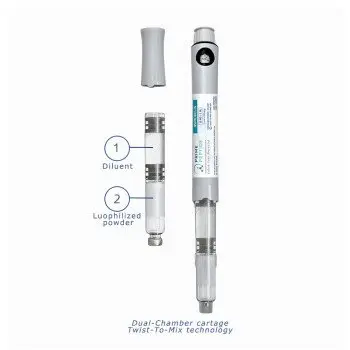
What is a Dual-Chamber Pen?
Dual-Chamber Pen technology allows the lyophilised peptide and solvent to be stored separately within a single pen. The system uses a special cartridge with two completely separate chambers: one contains the lyophilised peptide and the other contains the solvent. The two components remain hermetically isolated until activation.
The reason for this design is straightforward: peptides are generally more stable in lyophilised form than after dissolution. Once in contact with the liquid phase, chemical and physical degradation may gradually occur. Keeping the peptide in a dry, lyophilised state limits the time during which the prepared solution is exposed to these processes.
The design allows the contents of both chambers to be combined within the cartridge. The concept combines separate storage of a lyophilised peptide with an integrated cartridge system. It does not in itself establish product quality or suitability for medical use.
What is Ipamorelin?
Ipamorelin is a synthetic peptide in the GHRP (growth hormone-releasing peptide) group that stimulates the release of growth hormone (GH) from the pituitary gland. It acts through ghrelin receptors (GHS-R), which are involved in the regulation of growth hormone secretion.
Ipamorelin was developed in the 1990s as a more selective alternative to earlier peptides in the same group, such as GHRP-2 and GHRP-6. The aim was to develop a molecule that stimulates GH release without significantly increasing other hormones such as cortisol, prolactin or adrenocorticotropic hormone.
The peptide mimics the action of ghrelin, a natural signalling molecule involved in appetite, energy balance and GH release. Binding to ghrelin receptors triggers signalling to the pituitary gland.
Its comparatively limited effect on appetite in certain experimental settings has led to research into metabolism, tissue repair and hormonal regulation.
What potential effects of Ipamorelin are being investigated?
Scientific research examines Ipamorelin in the context of growth hormone stimulation and tissue repair.
- Growth hormone release: stimulation of pituitary GH secretion through ghrelin receptors.
- Tissue repair: research into muscles, tendons and other tissues in relation to GH physiology.
- Muscle growth: investigation of possible associations with muscle mass through GH and IGF-1 signalling.
- Metabolism: GH participates in fat metabolism and energy balance, prompting research into body composition.
- Ageing: research into age-related changes in GH secretion and cellular repair.
- Receptor selectivity: comparison of GH and other hormonal responses with those of certain GHRP peptides.
These areas of research do not establish clinically proven benefits in humans.
Scientific research on Ipamorelin
Studies have investigated its effects on growth hormone secretion. Experimental findings indicate stimulation of GH release via ghrelin receptors, with limited effects on cortisol and prolactin in certain settings.
Some scientific publications investigate its potential role in metabolism, tissue repair and hormonal regulation. Its receptor selectivity remains a topic of research.
Use in research protocols
Administration, dosing and duration depend on the specific approved research protocol. Available data are insufficient to establish a safe regimen for self-administration in humans. This text is not a guide to dosing, injection or combining substances.
Possible adverse effects of Ipamorelin
As with many bioactive peptides, adverse reactions may occur.
Reactions listed in the source:
- Mild redness at the injection site
- Headache
- Temporary fatigue
Other reported reactions:
- Mild nausea
- Dizziness
These reactions do not constitute a complete safety profile. Information on their frequency and long-term risks is limited. The FDA identifies potential significant risks associated with preparations containing ipamorelin acetate. Serious adverse events, including deaths, were observed in a clinical study involving intravenous administration, without an established causal relationship to the peptide. Source: FDA – risk assessment.
The information on this website is presented for informational purposes and is not intended to diagnose, treat or prevent disease.
The products shown in the demonstration catalogue are presented in a laboratory and research context, not for human or animal use. This demonstration website does not conduct active sales.