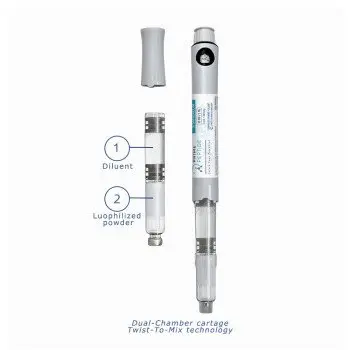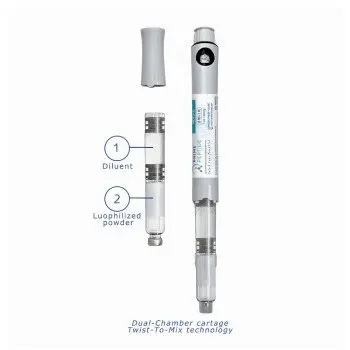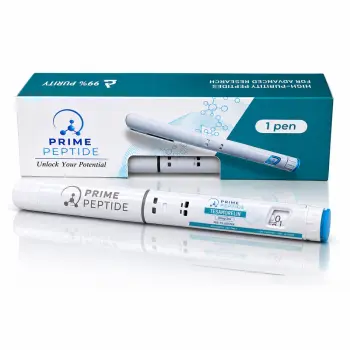


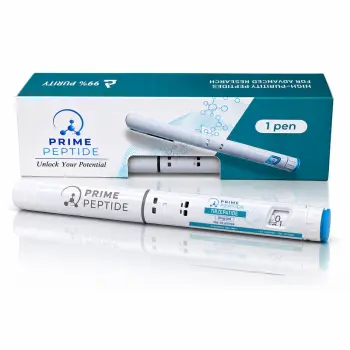
Tirzepatide | Pre-Filled Pen
136,25 €
Tirzepatide is a modern incretin peptide that acts as a dual agonist of the GIP and GLP-1 receptors. This sets it apart from classic GLP-1 compounds and makes it one of the most potent substances in current research on metabolism and body composition.
What is Tirzepatide?
Tirzepatide is a modern incretin peptide that acts as a dual agonist of the GIP and GLP-1 receptors. This sets it apart from classic GLP-1 compounds and makes it one of the most potent substances in current research on metabolism and body composition.
The peptide works through several key mechanisms at the same time. On the one hand, it reduces appetite by acting on the central nervous system, and on the other, it improves insulin sensitivity and glucose control. In addition, it slows gastric emptying, leading to a longer-lasting feeling of fullness.
Tirzepatide was originally developed for the treatment of type 2 diabetes, but it quickly became a subject of serious interest in research on weight loss and metabolic disorders.
Tirzepatide was first approved for type 2 diabetes in 2022, and later for the treatment of obesity and overweight. In the pharmaceutical industry, it is marketed under the brand names Mounjaro and Zepbound, which contain the same active molecule developed by Eli Lilly.
What are the benefits of Tirzepatide?
Tirzepatide stands out because it combines several key mechanisms that directly affect appetite, metabolism and body composition. This makes it one of the most effective compounds in this category.
-
Appetite control
Tirzepatide acts at the level of the central nervous system and leads to a clear reduction in hunger. In practice, this means lower calorie intake without the need for forced food restriction.
-
Weight loss
One of the peptide’s most powerful effects. Studies have shown a significant reduction in body mass, with a large part of the weight loss coming from fat tissue.
-
Improved insulin sensitivity
The peptide improves how the body responds to insulin, leading to better blood sugar control and a more stable metabolic environment.
-
Slowing of gastric emptying
This prolongs the feeling of fullness after eating and reduces the frequency of eating during the day.
-
Influence on energy balance
Tirzepatide not only reduces calorie intake, but also affects the way the body uses energy, making it effective in the long term.
-
Improvement in metabolic markers
It is associated with improvements in glucose levels, insulin and the lipid profile, making it a key tool in research on metabolic disorders.
-
Potential support for cardiovascular health
It is associated with improvements in weight, glucose control and the lipid profile, which are key factors for cardiovascular risk.
Clinical trials on Tirzepatide
Tirzepatide is one of the most intensively studied peptides in recent years, with large-scale clinical programmes and clear results.
In the SURPASS series of clinical trials, aimed at patients with type 2 diabetes, significant improvements in glucose control and weight reduction were observed. At doses of 5, 10 and 15 mg per week, participants achieved substantial reductions in HbA1c, as well as visible weight loss.
In SURMOUNT studies, which target obesity and overweight in people without diabetes, the results are even more impressive. At higher doses and with prolonged use, an average reduction in body weight of around 20% and more has been observed.
Additional analyses show that Tirzepatide has a stronger effect than classic GLP-1 analogues, precisely because of its dual mechanism of action on the GIP and GLP-1 receptors.
These results position it as one of the most potent compounds in current research on metabolism and body composition.
Correct administration and dosage of Tirzepatide within a research protocol
Tirzepatide is administered via a subcutaneous injection once a week, with the main principle being gradual dose escalation to improve tolerability.
A typical research protocol:
From 1 to 4 week 2.5 mg, from week 5 to 8 5 mg; if necessary and with good tolerability, the dose can be increased over four weeks by 2.5 mg, with a maximum allowed dose of 15 mg
The injections are administered at the same time each week.
Gradual titration (dose increase) is key, because it allows the body to adapt and significantly reduces the risk of side effects.
The protocol duration is usually between 8 and 16 weeks, and for long-term studies, even more prolonged administration may be used.
Possible side effects of Tirzepatide
As with all metabolic peptides, reactions are dose-dependent and most often occur at the beginning.
Most common:
- nausea
- reduced appetite
- stomach discomfort
- bloating
- constipation or diarrhoea
Less common:
- vomiting
- dizziness
- slight decrease in blood sugar
In most cases, symptoms decrease after adaptation to the dose, especially with proper titration.
The information on this website is collected and summarised from multiple scientific studies and analyses.
It is for general informational purposes only and is not intended for diagnosing, treating or preventing diseases.
The products offered on the site are not classified as medicines or medical devices and are suitable solely for laboratory and research purposes.