

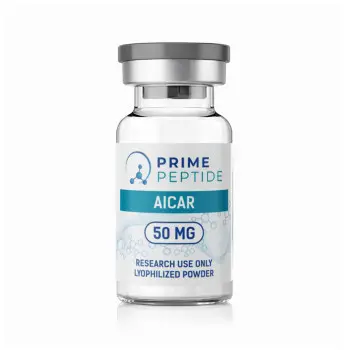
AICAR 50mg
50,00 €
AICAR (5-Aminoimidazole-4-carboxamide ribonucleoside), also known as Acadesine , is an experimental research compound studied primarily for its ability to influence AMP-activated protein kinase (AMPK) – one of the key cellular regulators of energy metabolism.
What is AICAR?
AICAR (5-Aminoimidazole-4-carboxamide ribonucleoside), also known as Acadesine, is an experimental research compound studied primarily for its ability to influence AMP-activated protein kinase (AMPK) – one of the key cellular regulators of energy metabolism.
Although AICAR is often found in the category of research peptides, technically it is not a peptide, but a nucleoside analogue.
After entering cells, AICAR is phosphorylated into the active metabolite ZMP (AICAR monophosphate). ZMP mimics part of the effects of AMP and can activate AMPK – a sort of cellular “energy sensor” that responds to changes in the cell’s energy status.
Activation of AMPK is associated with an increase in energy-producing processes and the limitation of some energy-intensive anabolic processes. Owing to this mechanism, AICAR is of serious interest in research into fat metabolism, glucose uptake, insulin sensitivity, mitochondrial function and physical endurance.
Preclinical studies on physical endurance are particularly well known. In animal models, pharmacological activation of AMPK through AICAR is associated with metabolic adaptations resembling part of the effects of training.
For this reason, AICAR is sometimes referred to as an “exercise mimetic”, although this definition is simplified and does not mean that the compound can reproduce all physiological effects of physical exertion.
AICAR is also investigated in the context of metabolic disorders, cardiovascular physiology, glucose metabolism, and various cellular processes regulated by AMPK.
AICAR is not approved as a medicinal product for routine therapeutic use by the FDA or EMA and is used mainly in scientific and research settings.
What are the benefits of AICAR?
Activating AMPK
AICAR is one of the best-known experimental tools for studying AMPK – a key regulator of cellular energy balance.
Supporting fat metabolism
Activation of AMPK is associated with increased oxidation of fatty acids and changes in the way cells use energy substrates.
Improving glucose metabolism
AICAR is studied for its potential influence on the transport and uptake of glucose by peripheral tissues.
Supporting insulin sensitivity
AMPK signalling is involved in regulating glucose homeostasis, which is why AICAR is of interest in metabolic research.
Increasing physical endurance
In preclinical models, AICAR has been associated with increased endurance and metabolic adaptations of skeletal muscle.
Supporting mitochondrial function
AMPK is involved in regulating mitochondrial biogenesis and cellular adaptation to increased energy demands.
Metabolic adaptation
AICAR is used to study the mechanisms by which cells shift from storing energy to using it.
Research on body composition
Due to its influence on lipid and glucose metabolism, AICAR is of interest in experimental models related to adipose tissue and body composition.
Research on muscle metabolism
The compound is used to study metabolic adaptations of skeletal muscle to energy deficit and physical exertion.
Clinical trials on AICAR
AICAR is a comparatively well-studied experimental compound and, unlike many research products, it has both substantial preclinical literature and data from studies in humans.
Under the name Acadesine, the compound has been investigated in clinical settings, including in relation to the cardiovascular system and ischaemic injury.
In separate human experiments, AICAR has also been used to study glucose metabolism, muscle physiology, and AMPK signalling.
However, much of AICAR’s popularity stems from preclinical studies on physical endurance. In a well-known animal model, pharmacological activation of AMPK is associated with a significant increase in endurance in untrained animals.
These results contribute to defining AICAR as an “exercise mimetic” and drive significant interest in the role of AMPK in adaptation of skeletal muscle.
However, results from animal models cannot be directly translated to humans and do not prove an equivalent effect on human physical performance.
AICAR has not received approval for routine use as a weight-loss agent, to improve sports performance, or to increase physical endurance.
Proper use and dosage of AICAR
There is no officially established or approved dosage for AICAR. In various experimental and research protocols, amounts of approximately 5 to 50 mg are encountered, with the most commonly discussed range being around 10–25 mg.
The duration of experimental protocols typically varies between 2 and 4 weeks, depending on the specific research model and the set objectives.
Significantly higher amounts have also been reported, but they are not supported by sufficient clinical data on safety and efficacy.
All the amounts listed are entirely experimental and are provided solely for scientific and informational purposes. They do not constitute a recommendation for use in humans or a medical dosage.
Possible side effects of AICAR
AICAR affects key mechanisms of cellular energy metabolism, which is why its potential effects are not limited only to skeletal muscle.
Depending on the experimental model and the degree of exposure, the following have been described or represent potential interest:
-
changes in blood glucose levels;
-
metabolic disorders;
-
gastrointestinal discomfort;
-
headache;
-
dizziness;
-
changes in uric acid levels;
-
effects on the cardiovascular system;
-
changes in cellular energy balance.
With longer-lasting or high exposure, the consequences of systemic AMPK activation have not been fully established.
The long-term safety profile of AICAR when used with the aim of changing physical performance or body composition has not been established.
Comparison of AICAR with other peptides and research compounds
AICAR vs MOTS-C
MOTS-C is a mitochondrially encoded peptide studied in relation to metabolic homeostasis, glucose metabolism, and cellular adaptation to energy stress. AICAR is not a peptide and acts more directly on AMPK signalling through its active metabolite ZMP.
AICAR vs 5-Amino-1MQ
5-Amino-1MQ is an experimental NNMT inhibitor and is studied in relation to NAD⁺ metabolism, adipose tissue, and energy balance. AICAR works through a different mechanism, with its main research target being AMPK signalling.
AICAR vs HGH Fragment 176-191
HGH Fragment 176-191 is a fragment of the growth hormone molecule and is studied primarily in relation to lipid metabolism. AICAR is not structurally related to growth hormone and affects cellular energetics via AMPK.
AICAR vs Growth Hormone (HGH)
Growth Hormone (HGH) acts via the GH receptor and the IGF-1 axis, and has widespread effects on growth, recovery, and metabolism. AICAR is not a hormonal agent and its main mechanism is linked to cellular energy signalling and AMPK.
The information on this website is collected and summarised from multiple scientific studies and analyses.
It is purely for informational purposes and is not intended for the diagnosis, treatment, or prevention of diseases.
The products offered on the site are not classified as medicines or medical devices and are suitable solely for laboratory and scientific research purposes.